


Cottonwood and Morrill Fires Update Friday, March 20
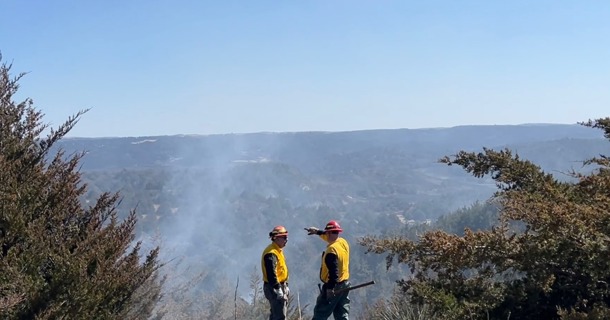
Current Situation: When fire managers develop fire-suppression plans and strategies, they rely on forecasts provided by the incident’s National Weather Service meteorologist. For several days, the incident management team has been informed of and preparing for the extreme fire weather conditions expected Saturday. For example, as the need for staffing the fire overnight has diminished, the night-shift firefighters will transition to day shift Saturday and become a dedicated initial-attack group, prepared to respond immediately if any new fires were to start. Additional resources on both the Cottonwood and Morrill Fires have been identified to assume initial-attack responsibility should the need arise. They will be available to assist local volunteer fire departments or state resources wherever they are needed in Nebraska.
The Morrill Fire is 98 percent contained, and the Cottonwood Fire is 80 percent contained. Containment pertains to how secure and resistant to spread the fire is. It does not indicate how much work remains in the overall suppression effort. Both fires burned across varied terrain, some of which is not easy to access by engines or on foot. The vegetation is also diverse—stands of cottonwoods and eastern redcedar are abundant—which can be difficult to extinguish when burning or smoldering. Each fire’s perimeter is large and winding: Cottonwood Fire’s is 259 miles and Morrill Fire’s is 399 miles. Methodically extinguishing heat sources near the perimeters is a time-consuming, but critical, phase of fire suppression.
Cottonwood Fire: The fire remains active in portions of Divisions A and D west of Jeffrey Reservoir. Dense stands of eastern redcedar untouched during the fire’s initial advance, are occasionally igniting and producing abundant smoke. However, the flare-ups are on the fire’s interior and are not expected to expand beyond existing firelines. Five twenty-person crews—one of which is Nebraska National Guard’s Air Guard Hand Crew—are constructing fireline with hand tools directly on the fire’s edge and extinguishing hotspots. Four National Guard Black Hawk helicopters from Nebraska and Iowa are being used to drop water on burning and smoldering vegetation in this area.
Morrill Fire: Crews observed minimal fire activity Thursday as they patrolled the perimeter and extinguished heat lingering in the duff layer, stumps, and roots. The National Guard’s Black Hawk helicopters are also being used in Division KK near the northwest end of Lake McConaughy. They are dropping water on hotspots near the uncontained southern perimeter that are hazardous to access with equipment or on foot. The entire perimeter is being patrolled.
Weather and Fire Behavior: Weather conditions Friday, the first day of spring, remain unseasonably hot and dry. Temperatures will reach the low to mid 80s, and relative humidity values will be near 10 percent. Northwest winds will be less than previous days, but 20 mph gusts are possible, especially near the Morrill Fire. Fire behavior is expected to be minimal Friday, allowing firefighters an opportunity to make significant progress along uncontained fire perimeters before critical fire weather conditions return Saturday. Expected weather conditions Saturday are 35 mph westerly wind, single-digit relative humidity levels, and record-setting temperatures in the low 90s. The all-time March record for this area of Nebraska, which is 92 degrees, is expected to be broken. Such extreme weather has potential to increase fire activity within fire perimeters as unburned vegetation ignites and readily burns, and any new fires would likely spread rapidly. If wildfire smoke is affecting your area, visit Fire.AirNow.gov for air-quality information.
Temporary Flight Restriction (TFR): If you fly, we can’t! Be aware that local TFRs (tfr.faa.gov) are currently in place in areas surrounding the Morrill and Cottonwood wildfires. These TFRs are in effect due to the significant increase in military and other aircraft engaged in direct firefighting support and the wildfire smoke that is hindering visibility in the area. We appreciate local aviators’ adherence to the flight restrictions and their assistance minimizing aerial traffic in these areas to keep our air crews safe as they support the fire-suppression effort.
Visit knowbeforeyoufly.org and remember: If you fly, we can’t!
Cottonwood Fire Statistics
Size: 128,036 ac.
Containment: 80%
Personnel: 246
Cause: undetermined
Morrill Fire Statistics
Size: 643,074 ac.
Containment: 98%
Personnel: 210
Cause: undetermined